
An Honest Cost and Performance Breakdown for Commercial & Industrial Facilities
For industrial facilities, commercial warehouses, agricultural buildings, and large‐scale operations across Northern Utah and the Cache Valley, choosing the right insulation is not just a matter of comfort. It’s a strategic decision that impacts operating costs, equipment performance, energy usage, regulatory compliance, and long-term building lifecycle value.
We frequently assist facility managers, plant operators, and construction partners who ask the same question:
“For commercial or industrial buildings, which insulation performs better? Spray foam or fiberglass?”
This article provides a clear, technical, and honest breakdown of how each material performs in commercial and industrial environments, what it actually costs over time, and what facilities in our region should consider before making a major insulation decision.
1. Understanding Commercial & Industrial Insulation Requirements
Industrial and commercial buildings experience vastly different conditions than residential structures. Instead of focusing on comfort for occupants, insulation in these environments must support:
- Energy efficiency across large volumes (high ceilings, open spans, large internal air volumes).
- Moisture and vapor control around production processes, machinery, and variable temperatures.
- Air infiltration management to prevent heat loss, ice dams, condensation, and HVAC strain.
- Building code requirements, including fire ratings and R-values for large facilities.
- Durability under equipment vibration, temperature fluctuations, and mechanical impacts.
- Return on investment (ROI) calculated over long operational timelines.
To evaluate the insulation materials used in these spaces, we must understand a few essential concepts:
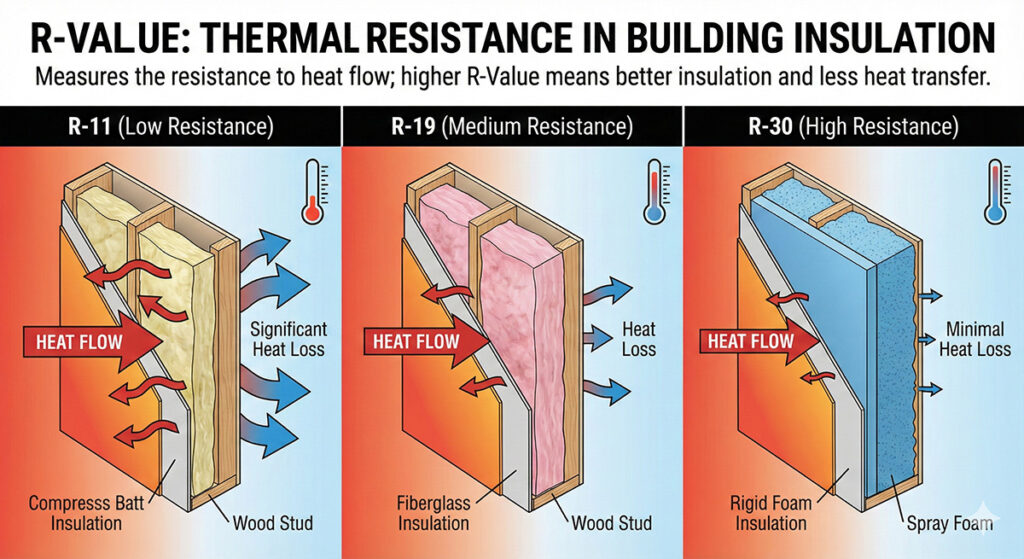
R-Value (Thermal Resistance)
R-value measures how well insulation resists heat transfer. A higher number indicates better thermal resistance. In large buildings where heating and cooling loads are massive, even a small improvement in R-value can significantly reduce utility costs.
Thermal Barrier vs. Air Barrier
A thermal barrier resists heat flow. An air barrier stops uncontrolled air movement.
Commercial buildings often require both, but most insulation materials only provide one by default. Spray foam provides both simultaneously, whereas fiberglass only provides a thermal barrier and must be paired with an air barrier system (membrane, sheathing, or mechanical sealing).
Moisture Management & Vapor Diffusion
Industrial buildings often deal with:
- Humidity from production processes
- Condensation from temperature differences
- Airflow around large overhead doors
- Ground moisture in warehouses
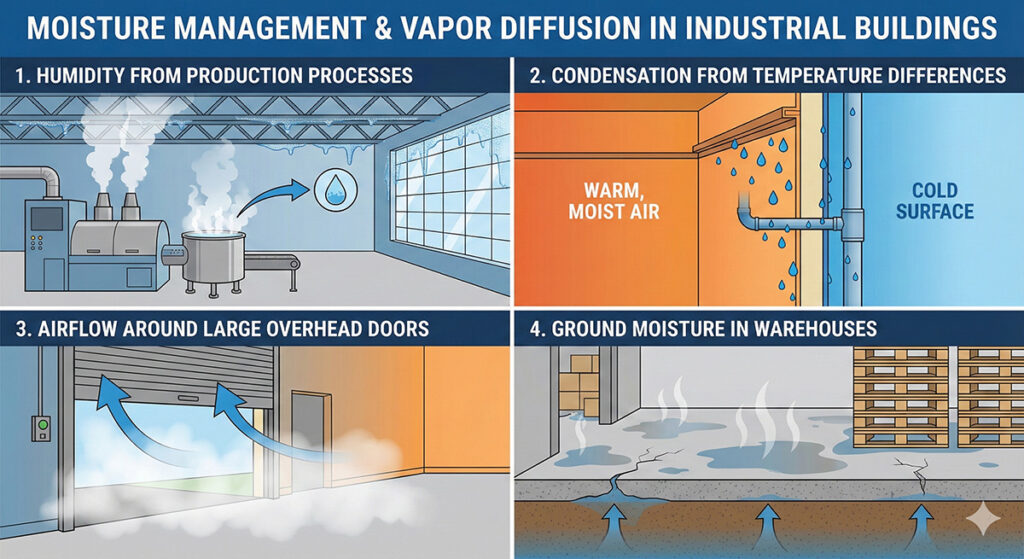
Industrial buildings often deal with:
Closed-cell spray foam is naturally moisture-resistant and sometimes functions as a vapor barrier, while fiberglass requires additional vapor control assemblies.
These differences become extremely relevant in Northern Utah, where winters cause dramatic interior/exterior temperature swings, which are a breeding ground for condensation problems if insulation is not properly selected.
2. Spray Foam in Industrial & Commercial Facilities
Spray foam comes in two primary forms, each suited to different applications:
Open-Cell Spray Foam
- Lower density
- Excellent sound absorption
- R-Value ~3.5-4 per inch
- Used in interior partitions or sound control situations
Closed-Cell Spray Foam
- High density, rigid, durable
- R-value ~6–7 per inch
- Functions as an air barrier and moisture barrier
- Adds structural rigidity to walls and ceilings
- Closed-cell foam is the workhorse of industrial insulation.
Where Spray Foam Excels in Industrial Settings
According to Knauf North America and NAIMA research, closed-cell spray foam provides superior performance in applications requiring air tightness and moisture resistance.
Key industrial benefits include:
- Superior air sealing (important in facilities with loading docks and overhead doors).
- Condensation control, helping prevent roof-deck moisture and corrosion.
- Mechanical durability, meaning it stays in place in high-vibration or heavy-use environments.
- Higher R-value per inch, ideal for metal buildings with limited cavity depth.
- Long service life with minimal maintenance.
Cost & Installation Considerations and ROI
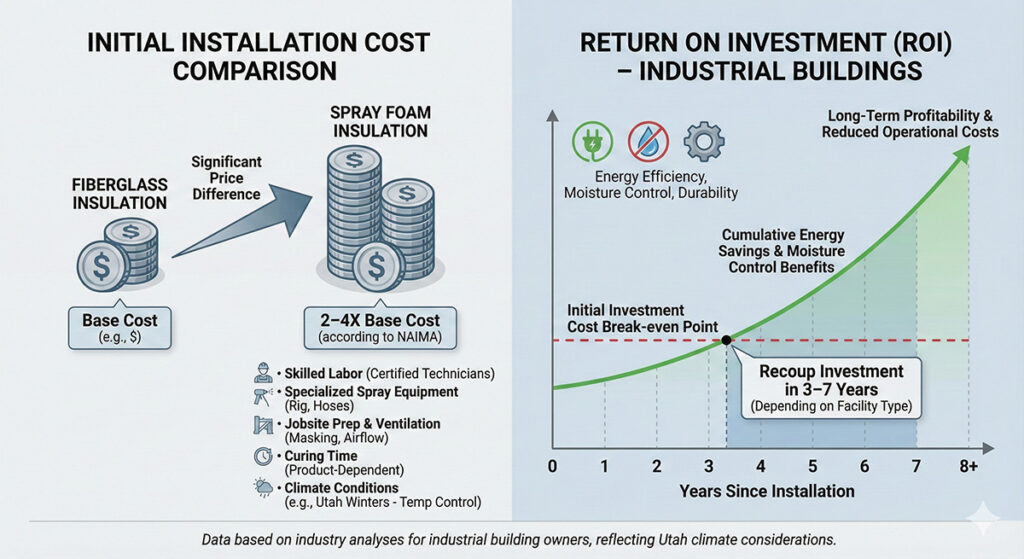
Spray foam typically costs 2–4 times more than fiberglass to install according to NAIMA and industry cost analyses. This reflects:
- Skilled labor requirements
- Specialized spray equipment
- Jobsite prep and ventilation
- Curing time depending on product
- Climate conditions (especially in Utah winters)
Return On Investment: Industrial building owners often recoup this investment through energy savings and moisture control within 3–7 years, depending on facility type.
3. Fiberglass in Industrial & Commercial Facilities
Fiberglass insulation has long been a standard for commercial construction due to its affordability and ease of installation.
Formats Used in Industrial Settings
- Batt insulation for framed commercial walls
- Metal-building insulation blankets (the large rolls with vinyl or facing)
- Blown-in fiberglass for attics or large horizontal surfaces
- Insulated panels where fiberglass is layered into manufactured assemblies
Strengths of Fiberglass for Industrial Applications
Based on Fastener Systems and NAIMA data, fiberglass remains cost-effective and widely used.
Key advantages include:
- Lower cost per square foot
- Large-scale availability
- Faster installation across expansive metal buildings
- Ease of repair or replacement
- Compatibility with standard commercial building systems
- No curing time
Limitations to Consider
- Does not stop air movement and must be paired with an air barrier
- Performance decreases if compressed or disturbed
- Vulnerable to moisture (loses R-value when damp)
- Can settle or sag in tall wall assemblies over time
- May require additional vapor protection to prevent condensation
Fiberglass can absolutely perform in industrial settings, but only when installed properly and paired with the right moisture and air-control systems. In Cache Valley’s climate, this is especially important.
4. Cost, ROI & Lifespan in Industrial Environments
The financial analysis differs significantly for commercial and industrial structures compared to homes.
Initial Installation Costs
According to NAIMA and industry averages:
- Fiberglass batt or metal-building insulation: $0.50–$1.50 per sq ft installed
- Open-cell spray foam: $0.50–$1.50 per sq ft (but often thicker layers are required)
- Closed-cell spray foam: $1.50–$3.50+ per sq ft depending on thickness and accessibility
Energy Savings & Payback
Spray foam’s superior air sealing causes the biggest long-term financial difference.
A closed-cell spray foam envelope can reduce industrial HVAC and heating costs by 25–50% depending on building size and usage.
For a 20,000 sq ft warehouse in Northern Utah, energy bills may exceed $30,000/year for heating and cooling. A 25% reduction delivers $7,500/year, meaning typical spray foam upgrades may pay for themselves in 3–6 years.
Durability & Lifecycle
- Spray Foam:
- 30–50+ year lifespan
- Minimal maintenance
- Does not settle or sag
- Adds rigidity to metal buildings
- Fiberglass:
- 15–30 year lifespan (can be shorter in harsh environments)
- Can be damaged by moisture, pests, airflow, or compression
- Requires more frequent inspection and replacement
In Northern Utah’s winter climate, where condensation inside metal buildings is common, closed-cell spray foam often outlasts fiberglass by decades simply because it doesn’t absorb moisture.
5. How to Decide What’s Right for Your Facility
At Impact Insulation, we evaluate each project based on its use case. Here’s how we recommend thinking about the decision:
Spray Foam Is Best For:
- Pole barns
- Food production facilities
- Warehouses with large HVAC loads
- Agricultural buildings (especially dairy and livestock)
- Metal buildings with condensation issues
- Breweries, distilleries, and facilities with humidity
- Cold storage or temperature-regulated buildings
- Buildings with limited wall cavity space
- Facilities wanting long-term ROI and reduced energy costs
Fiberglass Is Best For:
- Large structures needing cost-efficient coverage
- Pre-engineered metal buildings with basic insulation needs
- Facilities where air sealing is handled separately
- Projects with tight timelines or limited budgets
- Buildings with minimal moisture risk
- Spaces that may need frequent insulation access or replacement
In many industrial settings, a hybrid system performs best: spray foam on critical or high-moisture surfaces, fiberglass in large open spans to control cost.
6. Recommendation
For commercial and industrial clients in Northern Utah, Southeastern ID and Western Wyoming, choosing between spray foam and fiberglass comes down to performance needs and long-term operating costs.
- If your priority is high-performance insulation, reduced energy spend, condensation control, and long-term durability, closed-cell spray foam is the strongest choice.
- If your priority is low upfront cost and quickly insulating large square footage, fiberglass is an effective and economical option, as long as it is paired with proper air and vapor management.
- If you want the best mix of performance and cost, a hybrid insulation system may be ideal.
Ready to improve your facility’s efficiency?
Impact Insulation specializes in industrial and commercial insulation solutions designed for Northern Utah’s climate. Whether you’re a facility manager, industrial operator, contractor, or builder, we provide:
- Precise estimates
- Performance modeling
- Moisture and condensation diagnostics
- Professional-grade installation
- Spray foam, fiberglass, or hybrid systems
- Solutions tailored to large-scale industrial environments
Call us today or schedule your free on-site assessment to learn exactly which insulation system will deliver the best ROI for your facility.
Your building deserves insulation engineered for its demands. Let Impact Insulation make sure it gets the right solution.
Have Questions About Spray Foam Insulation?
Every building is different. If you’re wondering whether spray foam is right for your home or building, our team is happy to help.