
Without the right insulation system, metal structures are notoriously difficult to heat, cool, and protect from condensation. That’s why more owners are turning to spray foam as a long-term solution. When installed correctly, integrated insulation and roofing principles make this technology uniquely suited for metal buildings, delivering both thermal performance and moisture control in a single application.
Metal buildings are everywhere today, from backyard shops and agricultural barns to large-scale warehouses and commercial facilities. They’re durable, cost-effective, and fast to construct. But they also present one of the biggest insulation challenges in modern construction.
Why Metal Buildings Are Hard to Insulate
Unlike wood-framed structures, metal buildings conduct heat rapidly. Steel panels transfer exterior temperatures directly into the building envelope, which can turn interiors into ovens in the summer and refrigerators in the winter. Traditional insulation methods often struggle to address this effectively.
This challenge is especially noticeable in four-season states like Utah. In Northern Utah, where we regularly see 100°F summer days and sub-zero winter temperatures, the constant expansion and contraction of metal panels can create gaps in traditional insulation systems. Those gaps allow air movement, reduce thermal performance, and increase condensation risks.
Beyond temperature swings, condensation becomes a serious concern. Warm, humid interior air meeting cold metal surfaces creates moisture, which can lead to dripping, corrosion, mold risks, and damage. Many metal building owners first notice problems not through comfort issues, but through water stains or rust.
The root problem is not just insufficient insulation; it’s uncontrolled air movement combined with highly conductive materials.
How Spray Foam Solves the Core Problems
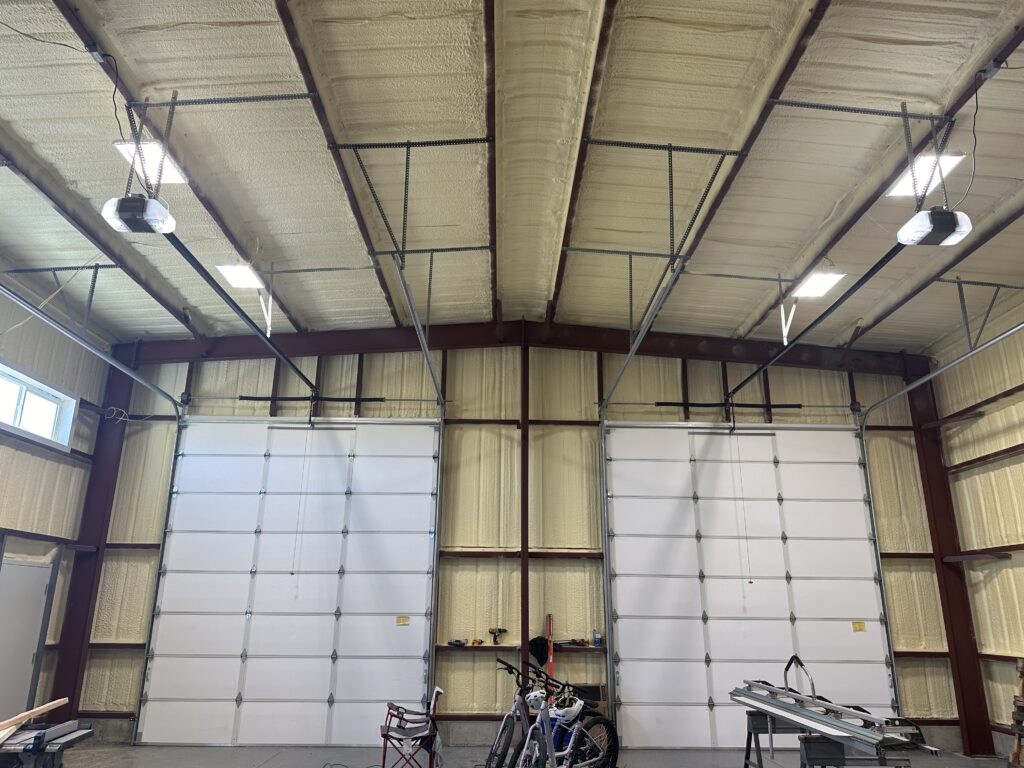
Spray foam behaves differently from conventional insulation because it expands, seals, and adheres directly to metal surfaces. Instead of simply slowing heat transfer, it creates a continuous air barrier that dramatically reduces the mechanisms responsible for energy loss and condensation.
By bonding directly to the underside of metal panels, spray foam eliminates the gaps and voids that allow warm air to circulate and condense. In climates like Utah’s, where buildings are constantly expanding and contracting, spray foam moves with the structure and maintains that seal.
Rather than treating insulation and air sealing as separate concerns, spray foam addresses them simultaneously.
Condensation Control: Why Closed-Cell Foam Matters
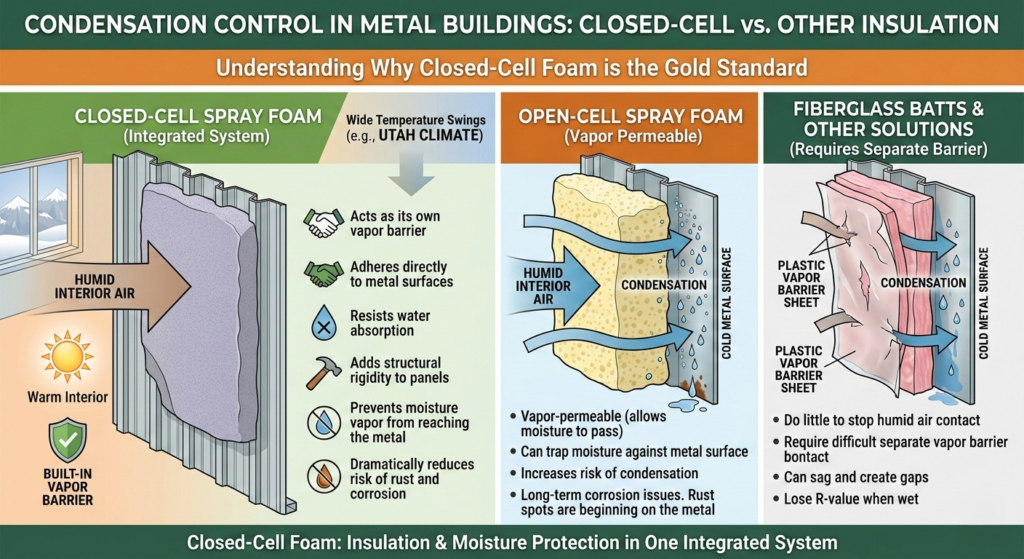
For many shop owners, warehouse operators, and barn builders, condensation is the single most frustrating issue. Fiberglass batts and similar materials may provide some thermal resistance, but they do little to stop humid air from contacting cold metal surfaces.
When insulating metal buildings, closed-cell spray foam is widely considered the gold standard.
Closed-cell foam:
- Acts as its own vapor barrier
- Adheres directly to metal surfaces
- Resists water absorption
- Adds structural rigidity to panels
Because of its dense, closed-cell structure, it prevents moisture vapor from reaching the metal in the first place. This dramatically reduces the risk of rust and corrosion.
By contrast, open-cell foam is vapor-permeable. Without a properly installed and separate vapor barrier, it can allow moisture to pass through and potentially trap it against the metal surface, increasing the risk of condensation and long-term corrosion issues.
For metal buildings, especially in climates with wide temperature swings like Utah, closed-cell foam provides both insulation and moisture protection in one integrated system.
Without constant moisture cycling, building materials last longer, stored items remain protected, and interior environments feel more predictable year-round.
Comfort and Energy Efficiency Improvements
Metal buildings frequently suffer from extreme temperature fluctuations. Heating systems struggle to keep up in winter, while summer heat gain makes cooling expensive or ineffective. Spray foam significantly reduces this volatility by creating a high-performance thermal envelope.
Because spray foam resists both conductive heat transfer and uncontrolled air leakage, interior temperatures stabilize more easily. HVAC systems operate more efficiently, and many owners report noticeably reduced energy costs along with improved occupant comfort.
What surprises many property owners is how dramatic the difference feels once air infiltration is controlled. Drafts disappear, radiant heat effects are reduced, and the building behaves more like a conditioned structure rather than a thin metal shell.
Structural and Durability Benefits
In addition to insulation performance, closed-cell spray foam adheres directly to metal panels and framing members. This fully bonded characteristic can add rigidity to certain assemblies and reduces the risk of insulation sagging or shifting over time.
Unlike loose or mechanically supported insulation systems, spray foam remains fixed in place. It does not settle, compress, or lose effectiveness due to gravity or vibration — an important consideration in workshops, equipment buildings, and agricultural structures like barns.
Ideal Applications for Spray Foam in Metal Buildings
While spray foam works in a wide variety of projects, it is particularly valuable in structures where temperature control and condensation prevention are critical. This commonly includes:
- Workshops and hobby shops
- Commercial warehouses
- Agricultural barns and storage buildings
- Equipment and utility structures
Each of these environments benefits from spray foam’s ability to combine insulation, air sealing, and moisture management into a single system.
A Smarter Insulation Strategy for Metal Structures
Metal buildings are inherently efficient to construct, but without proper insulation, they can become inefficient to operate. Spray foam offers a solution specifically suited to the realities of steel construction by addressing the two biggest challenges: heat transfer and condensation.
For shops, warehouses, and barns, spray foam is not simply another insulation option; it is often the system that allows the building to perform as intended.
Considering spray foam for your metal building?
Impact Insulation can evaluate your structure and help you determine the most effective, long-lasting insulation approach for Utah’s demanding climate.
Have Questions About Spray Foam Insulation?
Every building is different. If you’re wondering whether spray foam is right for your home or building, our team is happy to help.